You don’t need a factory, a warehouse, or a shipping label. What you need is knowledge, a little direction, and the right starting point.
Imagine waking up on a Tuesday morning, making yourself a cup of coffee, and seeing a notification on your phone that says “You made a sale.”
You didn’t do anything. You were sleeping. But someone, somewhere, found your product online, clicked buy, and paid you money.
That’s the dream that millions of people are quietly turning into reality by selling digital products.
And the reason it works is simple — a digital product can be made once and sold forever, to anyone, anywhere, with zero shipping costs and zero inventory headaches.
But before we get into the how, let’s answer the most fundamental question: what is a digital product, exactly?
If you’ve been curious about building an online income stream but feel overwhelmed by where to start, you’re in exactly the right place.
This guide will walk you through everything — from understanding the basics to finding your best digital product ideas and making your very first sale.
What Is a Digital Product?
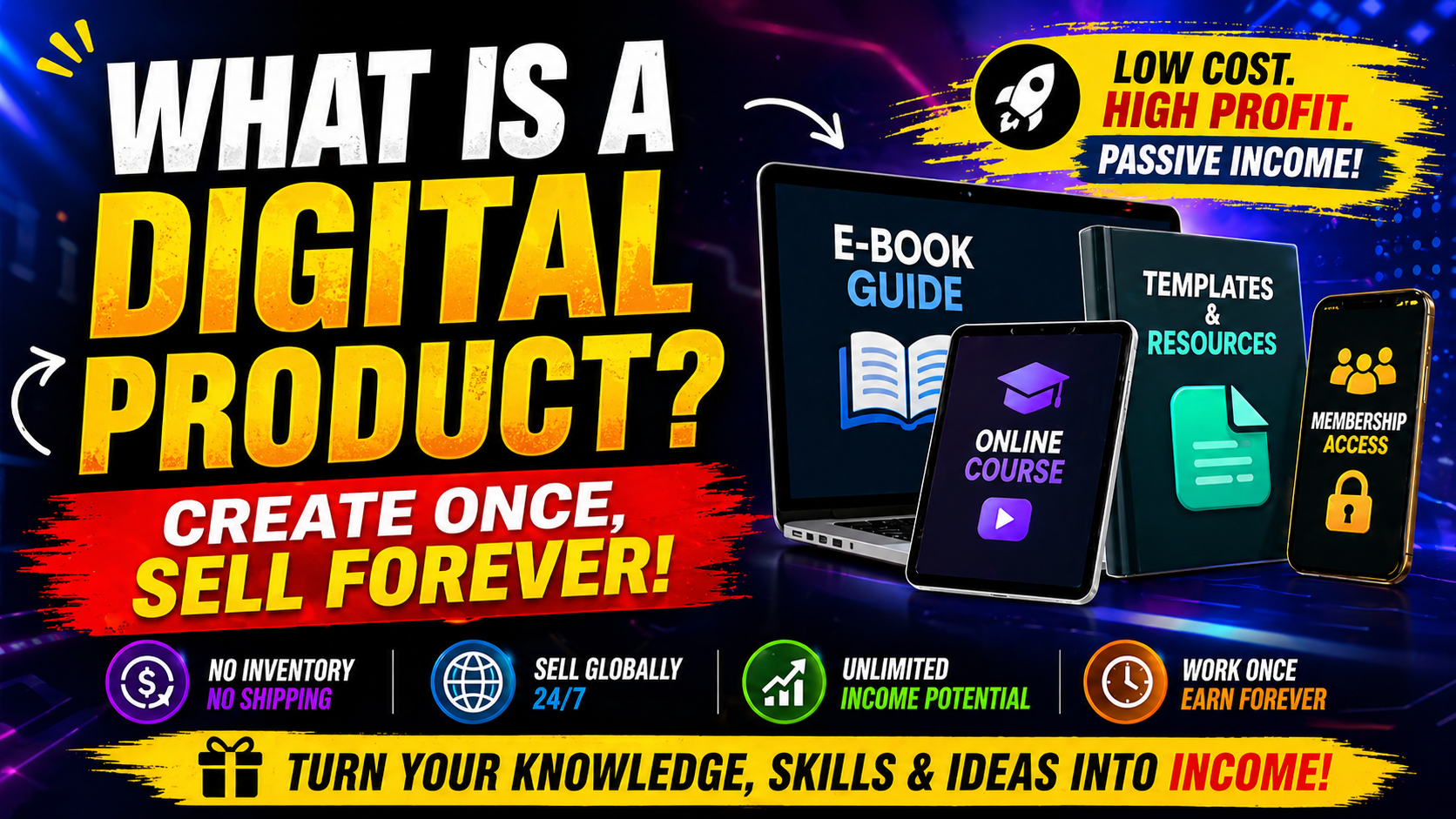
A digital product is any item or piece of content that exists in a digital format and can be delivered to a buyer instantly, online, without any physical shipping.
There’s no box, no postage, no warehouse — just a file or access link that lands in the customer’s inbox or account the moment they pay.
Digital products can be incredibly varied. Some of the most common types include:
- eBooks and written guides
- Online courses and video lessons
- Templates (for design, documents, spreadsheets)
- Printables and planners
- Music, audio files, and sound effects
- Lightroom presets and photo filters
- Software, plugins, and apps
- Stock photography and digital art
- Notion templates and productivity systems
- Coaching programs and membership communities
What makes digital products so compelling is the economic model. You put in the effort once to create it, then every sale after that is essentially pure profit, minus your platform fees and any marketing costs.
There’s no “out of stock” problem. No restocking. No logistics.
“The first time I made a sale while I was on a walk with my dog, I realised this was actually real. It felt like someone left money in my mailbox.” — A first-time digital product creator
What Makes Digital Products So Special Right Now?
We’re living in an era where people want instant answers and immediate solutions. Nobody wants to wait two weeks for a book to ship — they want the PDF in their inbox now. That shift in consumer behaviour has opened a massive window for anyone willing to package their knowledge or creativity into a downloadable format.
Here’s why digital products have exploded in popularity:
Incredibly low startup costs
You can create your first eBook or template using free tools like Canva, Google Docs, or Notion. Compare that to starting a physical product business, which can cost thousands before you even sell a single unit.
Passive income potential
Once your product is listed, it can sell while you sleep, travel, or spend time with family. Your effort is front-loaded; the returns can keep coming for years.
Global reach from day one
A person in Mumbai, Manchester, or Mexico City can buy your product at 3 a.m. on a Sunday. Geography is simply not a barrier.
Instant delivery means happy customers
Digital buyers get what they paid for immediately. That means fewer complaints, better reviews, and much less customer service overhead compared to physical goods.
Best Digital Product Ideas to Start With
One of the most common questions people ask when they first learn about this business model is: “What should I actually sell?” The good news is that digital product ideas are everywhere — you just need to look at what you already know.
Think about your profession, your hobbies, your side skills. Can you teach someone how to do something in less time? Do you have a system that saves you hours every week? Do people ask you for advice regularly? All of that is raw material for a digital product.
High-converting digital product ideas by category
- Professionals: Resume templates, proposal templates, client onboarding kits, workflow SOPs
- Creatives: Canva templates, Lightroom presets, Procreate brushes, font bundles
- Educators: Mini-courses, study guides, quiz packs, lesson plan templates
- Coaches: Workbooks, goal-setting journals, 30-day challenge kits
- Fitness enthusiasts: Workout plans, meal planning guides, habit trackers
- Personal finance experts: Budget spreadsheets, savings calculators, financial planning guides
The best digital product ideas are not necessarily the most complex. A simple, well-designed budget spreadsheet can outsell a 10-module course if it solves a specific, pressing problem. Focus on specificity — the more targeted your solution, the easier it is to market and sell.
Why So Many People Choose to Sell Digital Products Online
It’s not just about the convenience of not having to ship things. Selling digital products online gives you access to systems and platforms that make the entire business almost frictionless.
You can set up a product listing, connect a payment processor, automate the delivery, and go to bed — all before your first customer finds you. That kind of automation used to require a team. Now, a solo creator can handle it all.
Compared to freelancing or services work, digital products scale beautifully. When you’re a freelancer, your income is capped by your hours. When you sell a digital product, a good week of marketing can result in hundreds of sales without you lifting a finger past the initial setup.
That’s not to say it’s effortless — building an audience and getting your first sale takes real work. But the ceiling on what you can earn is dramatically higher with products than with time-for-money work.
Places to Sell Digital Products: Where Should You List Yours?
Choosing the right places to sell digital products is one of the most important early decisions you’ll make. The platform shapes your audience, your fees, your branding options, and how much control you have over the customer relationship.
Here are the most reliable options in 2026:
Gumroad
Gumroad is beginner-friendly, free to start, and handles payments and delivery automatically. It’s one of the most popular places to sell digital products for first-time creators because the barrier to entry is nearly zero. You can have a product listed within an hour.
Etsy
Etsy is a massive marketplace with built-in search traffic. It works particularly well for printables, planners, templates, and digital art. The downside is that you’re competing with many other sellers, and Etsy controls the customer relationship.
Payhip
Payhip offers a clean storefront experience with generous features on the free plan. It’s an excellent alternative for sellers who want more branding control than Gumroad while still avoiding a monthly fee.
Teachable / Thinkific
If your digital product is an online course or coaching program, these platforms are purpose-built for you. They handle video hosting, student management, and payment processing in one place.
Your own website (Shopify or WordPress/WooCommerce)
Once you’re generating consistent sales, moving to your own website gives you full ownership of the customer relationship, zero marketplace competition, and better profit margins. It takes more setup, but it’s worth it at scale.
How to Choose the Right Digital Product to Create
Not every digital product idea is worth your time to build. Before you sit down to create anything, run your idea through this simple filter:
- Is there a clear problem being solved? Buyers pay for outcomes, not content. If your product doesn’t solve something specific, it won’t sell.
- Can you articulate who it’s for? “Freelancers who struggle to write client proposals” is a much better target than “anyone who needs help writing.”
- Is it something you know well enough to teach or create at a high standard? Credibility matters, even if you’re not a formal expert.
- Is there evidence of demand? Check Etsy, Reddit, Pinterest, and Google Trends. If people are searching for it or already buying similar products, that’s a green light.
- What’s the realistic price point? A simple printable might sell at ₹200–₹800. A comprehensive course could sell at ₹5,000–₹20,000 or more. Know where your product sits.
Different Types of Digital Products Explained
Understanding the landscape of what is a digital product helps you find your niche more confidently. Here’s a breakdown of the main categories and when each one makes sense:
Downloadable files (PDFs, templates, spreadsheets)
These are the fastest to create and easiest to sell. They work especially well for practical, task-oriented buyers — someone who needs a contract template today isn’t going to take a 6-week course first.
Online courses and workshops
Higher-priced and higher-effort to build, but they deliver transformation — not just information. Buyers of courses want a guided experience and measurable results. If you have a skill others want to develop, a course is often the highest-leverage product you can build.
Memberships and subscriptions
Instead of a one-time purchase, you offer ongoing access to content, community, or tools for a recurring fee. This creates predictable monthly income and deeper customer loyalty.
Digital art and media
Stock photos, illustrations, fonts, music tracks, and video clips are all digital products. If you’re a creative professional, licensing your work digitally is one of the most passive income streams possible.
Software and tools
Apps, browser extensions, plugins, and automation scripts solve highly specific problems and can command premium prices. The technical bar is higher, but so is the earning potential.
Who Should Be Selling Digital Products Right Now?
Here’s a short answer: almost anyone with a skill, an audience, or specialised knowledge.
Digital products are ideal for:
- Freelancers who want to add a passive income stream alongside their client work
- Teachers and educators who want to reach students beyond their classroom
- Side-hustle seekers who want a low-risk business model to test
- Content creators (bloggers, YouTubers, Instagrammers) who have an engaged audience already
- Professionals who want to monetise their expertise without consulting one-on-one
- Stay-at-home parents looking for flexible income opportunities
The honest truth is this: if you’ve ever thought “I know something that could help people,” you probably have the foundation for a digital product already.
Tips Before You Buy Into Any “Zero to First Sale” Program
There are dozens of courses, communities, and programs out there promising to help you make your first sale online. Some of them are excellent. Others are overpriced fluff. Before you invest in any program centred around what is a digital product and how to sell one, here’s what to check:
- Is there a clear curriculum or roadmap? You need to know exactly what you’ll learn, step by step — not just vague promises of income.
- Does the instructor have real results? Look for case studies, student testimonials with specifics, and verifiable proof of sales.
- Is the community active? A private group or support forum where you can ask questions is worth a lot, especially when you hit your first roadblock.
- What’s the refund policy? Legitimate programs stand behind their product. A money-back guarantee signals confidence in what’s being taught.
- Is it updated for the current year? Platforms change, algorithms shift, and what worked in 2020 may not work the same way now. Look for programs that are actively maintained.
Mistakes First-Time Digital Product Sellers Make
Most people who fail to make their first digital product sale don’t fail because their idea was bad. They fail because of avoidable mistakes in how they launched or positioned their product. Here are the most common ones:
Waiting until the product is “perfect”
Perfectionism kills more digital businesses than competition ever does. A version-1 product in the hands of real customers is infinitely more valuable than an unpublished masterpiece.
Choosing a topic they love rather than one people will pay for
Passion is important, but it doesn’t pay bills. Validate your idea with real market research before spending weeks building something.
Skipping the audience-building phase
Even a small, warm email list of 200 people who trust you is worth more than 10,000 cold social media followers. Building relationships first makes selling much easier.
Pricing too low out of fear
Underpricing your product doesn’t just hurt your revenue — it can actually lower the perceived value. Buyers often equate low price with low quality.
No plan for marketing after launch day
Putting your product on Gumroad and waiting is not a marketing strategy. You need a consistent plan for driving traffic through content, social media, email, or ads.
Why Buying a Structured Program Like Zero To First Sale Is a Smart Move
Here’s something the self-taught-by-YouTube crowd won’t always admit: scattered, free information is often more expensive than a paid course — because the cost of confusion is time, failed experiments, and delayed results.
A structured program built around getting your first digital product sale takes all the guesswork out of the process. Instead of piecing together 50 different blog posts and YouTube videos, you follow a proven path from “I have an idea” to “I have money in my account.”
Programs like Zero To First Sale are designed specifically for people who are starting with nothing — no audience, no product, no experience.
That’s their whole point. If you’re wondering what is a digital product and whether you can actually sell one, a program like this meets you exactly where you are and moves you forward, step by step.
You’ll cover things like:
- How to validate a digital product idea before you build it
- Which platform to start on based on your product type
- How to price your product with confidence
- How to write a product description that converts browsers into buyers
- How to drive your first sales without a big following
- How to set up automations so your product sells on autopilot
That kind of structured, sequenced guidance is genuinely hard to replicate by piecing free content together. The value is in the curation — knowing what to do, in what order, and why.
The Bottom Line: Your First Digital Product Sale Is Closer Than You Think
So — what is a digital product? It’s your skills, your knowledge, and your creativity packaged into something someone else will pay for.
It’s a budget spreadsheet that helps a stressed-out twenty-something finally get their finances under control.
It’s a Canva template that saves a small business owner three hours every week.
It’s a mini-course that teaches a complete beginner exactly how to do something you do every day without thinking.
The market for digital products is not saturated — it’s growing. More people are buying online learning, tools, and resources than ever before, and the number of confident buyers keeps rising.
The only question is whether you’ll be on the selling side of that transaction.
If you’re serious about turning your knowledge into income and want a clear, structured path to your first sale, then investing in a program like Zero To First Sale is one of the most practical moves you can make.
Stop wondering, stop watching from the sidelines, and take the first step. Your first sale is not some distant milestone — it’s a real, achievable goal that people are hitting every single day.
The only difference between them and you is that they started.
Frequently Asked Questions
What is a digital product, and do I need technical skills to create one?
A digital product is any file or content that can be delivered electronically — eBooks, templates, courses, presets, and more. Most digital products don’t require technical skills at all. A well-designed PDF template or a practical workbook can be created entirely in Canva or Google Docs, which are both free and beginner-friendly.
How long does it take to make your first sale selling digital products?
It varies significantly based on your approach. Some creators make their first sale within days of launching, especially if they already have a small audience. Others take a few months while they build visibility. Structured programs like Zero To First Sale are specifically designed to compress that timeline by giving you a clear, tested roadmap.
What are the best digital product ideas for beginners with no experience?
The best starting point is almost always a simple, specific solution to a real problem. Great beginner digital product ideas include printable planners, Canva social media templates, resume or cover letter templates, meal planning guides, and niche eBooks. These are quick to create, easy to price, and have proven demand across platforms like Etsy and Gumroad.
What are the best places to sell digital products online?
The most beginner-friendly places to sell digital products include Gumroad, Etsy, and Payhip. For courses and coaching products, Teachable and Thinkific are strong options. Once you’re ready to scale, building your own website with Shopify or WooCommerce gives you the most control and the best profit margins.
Is selling digital products actually profitable, or is it oversaturated?
The digital product market is large and growing — it’s far from oversaturated. The key to profitability is specificity. Generic products in crowded categories struggle. But a niche, well-positioned product that solves a precise problem for a defined audience can be highly profitable even with a small marketing budget. The creators who succeed are those who solve real problems, not those who simply follow trends.